Kyoto Prefecture · Ujitawara · early November to late December
What Uji's Tea Farmers Dry in Winter
Thirty minutes by bus beyond Uji, tea country runs out of tea work in November. Then tall straw-roofed racks go up in the harvested rice paddies, and thousands of small peeled persimmons hang in them for a few weeks. By the end of December the racks are gone.
柿屋 kakiya · 古老柿 korogaki宇治田原町 UjitawaraFacts checked November 2026
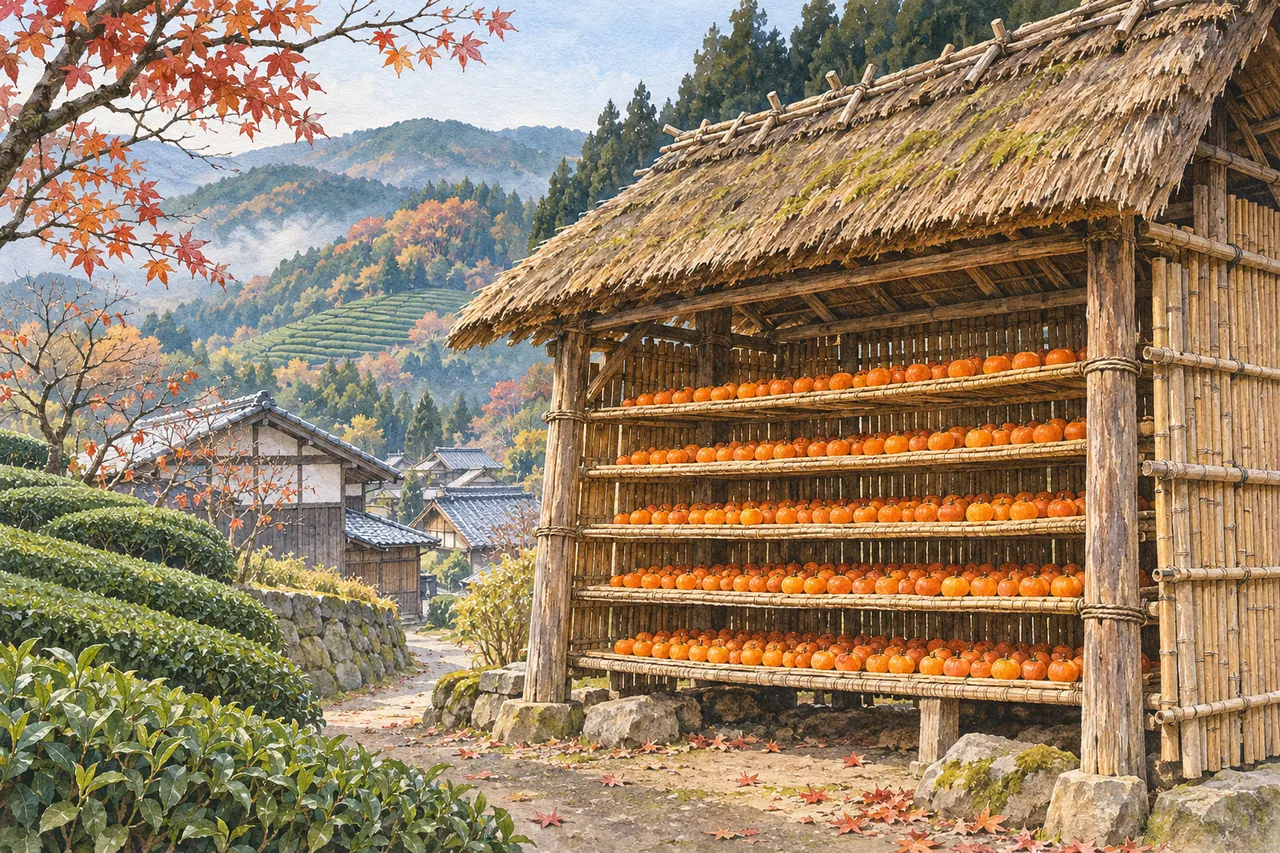
AI-generated illustration. A kakiya drying hut in the autumn landscape of Ujitawara.
You have done Uji: Byōdō-in, the river, a matcha parfait on the approach street. Uji is where the famous tea is sold. Much of the growing, and much of the history, is further up the valley in Ujitawara (宇治田原町), a farming town in the hills to the east that most visitors only reach for one Instagram window.
Late autumn is the odd season to go. The tea bushes are dormant and the town's tea events are over. But this is exactly when Ujitawara does something no other place in Japan does in quite this way. Kyoto Prefecture describes it as the only place in the country making korogaki in kakiya: dried persimmons cured in big temporary drying sheds built by hand in the fields.
The trade-off is real. Buses are infrequent, the sights are spread over several kilometres of hill farmland, the persimmon sheds are on private farms and nobody publishes a map of them. What you get is a working winter landscape that only exists for about seven weeks a year, and the chance to order a sweet that sells out by February.
Why persimmons in a tea town古老柿 · korogaki
Tea is a spring and summer crop. Picking, steaming and rolling run from the new-tea season into summer; by November there is little to do. A 2008 paper in the Architectural Institute of Japan's journal describes a tea-farming family using its kakiya to make dried persimmons in exactly that slack season. Hibiki-an, a Uji tea merchant that sells korogaki, says the same thing more plainly: it was traditionally a side job for tea farmers between seasons.
The fruit is tsurunoko-gaki (鶴の子柿), a small, slender, astringent persimmon that cannot be eaten fresh. Drying turns the tannins harmless and the sugars rise to the surface as a fine white powder. That powder gives the sweet its name. Kyoto Prefecture lists three explanations, all still in circulation:
The label on the packet will almost always say 古老柿; match it to that, not to the romaji.
Seven weeks in a field柿屋 · kakiya, "persimmon house"
A kakiya is a tall open-sided rack of logs and bamboo with shelves inside and a straw roof that lets the wind through. Kyoto Prefecture says they start going up in harvested rice paddies from early November, are built entirely by hand, and come down at the end of December. The architecture paper notes that they are reused every year with very little waste. Hibiki-an gives one example: about 10 m high and 12 m long, six shelves, and two people about five days to build.
The prefecture's own sequence: the fruit is picked with a bamboo pole split into a fork at the tip; the calyx is cut away and the fruit peeled; then it sits on the kakiya shelves for 15 to 20 days. Every evening the farmers cover it with sheets or straw mats, and they move it when the weather turns. Half-dried, it comes down onto mats for about a week of what Ujitawara calls odoraseru (踊らせる), making them dance: tossing and rolling, once in a winnowing basket, now often in a rotating machine, until the white powder appears. The season's first market is in mid-December.
You can see the racks full or buy the finished sweet, rarely both on one trip: the fruit is still hanging when the shops have nothing to sell.
Where: Harvested rice paddies around Ujitawara. Neither the prefecture nor the town publishes locations, and they change year to year.
When: Built from early November, taken down at the end of December. The fruit is drying through late November and early December.
Reality check: These are private working farms. Look and photograph from the road; do not walk into the paddy or touch the fruit. The fruit is covered every evening, so go in daylight.
The simplest way to find one is to ask where the persimmon is sold. At the JA shop (below), try:
柿屋はどこで見られますか (kakiya wa doko de miraremasu ka). Expect a pointed finger and a direction rather than an address.
Buying it: order now, collect later宇治茶の郷 · Ujicha no Sato
Korogaki is sold from mid-December into January and is almost gone by February. Output depends on the weather and sales can stop early. Most producers make to order, and the prefecture's own advice is to ask or reserve during November. The prefecture lists the JA Kyoto Yamashiro shop Ujicha no Sato as the place to ask, alongside tea shops and supermarkets in town and a few shops in Kyoto's Nishiki Market.
古老柿を予約したいです (korogaki o yoyaku shitai desu). Then be ready to say when you can collect it, or ask whether they can post it to your hotel.
Address: 京都府綴喜郡宇治田原町郷之口中林12. Tel 0774-88-2629.
When: Weekdays 9:30–15:30; weekends and holidays 9:30–16:30 (2026 prefectural guide, "subject to change"). Closed over New Year.
Reality check: No official price is published. If you are in Japan only in late November, you may be able to reserve but not collect.
The girl who taught the village禅定寺 · Zenjōji
The legend behind 孤娘柿 belongs to Zenjōji (禅定寺), a temple founded in 991 by a former senior monk of Tōdai-ji. Long ago, the story goes, nobody here knew how to make astringent persimmons sweet. A girl taught the village how to dry them, and she turned out to be the temple's Eleven-Faced Kannon. In 1993 a statue of her, the Otome Kannon (乙女観音), also called the persimmon-tree Kannon, was placed near the stone tied to the legend. It is set a little apart inside the temple grounds, and the temple asks visitors to tell them before going to it.
乙女観音にお参りしてもいいですか (otome kannon ni omairi shite mo ii desu ka). Ask at the temple office before you walk round to it.
The temple's real treasure is a Heian-period standing Eleven-Faced Kannon, an Important Cultural Property, kept in its treasure hall with other Heian sculpture. The thatched main hall is 17th century. The temple garden has its own persimmon trees, dried every year.
Getting there: About 40 minutes on foot from the Ichūmae (維中前) bus stop, or about 30 minutes from Nagayamaguchi (長山口). Address 禅定寺小字庄地100; tel 0774-88-4450.
Reality check: We could not confirm opening hours, the admission fee or which days the treasure hall opens. Call before you build a day around the statues.
Where the tea came from湯屋谷 · Yuyadani
The other half of the story is tea, and it is already told in English, so briefly. In 1738 Nagatani Sōen (永谷宗円), a farmer in the valley of Yuyadani, is said to have perfected after fifteen years a way of rolling steamed leaves before drying them. It produced green tea with better colour and aroma, and he shared the method freely. Kyoto Prefecture credits it as the source of most Japanese green tea today, with a careful "it is said".
What visitors usually miss is that Yuyadani is a deep valley with no tea fields of its own. Its street is lined with tea wholesalers because their customers were far away, mainly in Edo. The house shown as Sōen's birthplace was rebuilt by residents in 1960 on the family's site to protect the original hoiro, the tea-drying hearth, which survives inside. Behind it is the Chasō Myōjin shrine (茶宗明神社), where Sōen is enshrined and which tea businesses across Japan helped pay for.
Getting there: Bus to Kōgyō Danchi-guchi (工業団地口), then about 35 minutes on foot. By car, park at Yantan (below) and walk about 15 minutes. The town's community bus asks non-residents not to use it for sightseeing.
When: The birthplace interior opens on Saturdays, Sundays and holidays only, until 17:00; sources disagree on whether it opens at 9:00 or 10:00. Free.
Sōen Kōyūan Yantan (宗円交遊庵やんたん): the village's tea house and base, 湯屋谷尾華21, tel 0774-46-8864. November–February 10:00–16:00; closed Wednesdays, Thursdays and 28 December–5 January (hours from a 2024 guide; check before you go).
The window you may already know正寿院 · Shōjuin
If you have heard of Ujitawara at all, it is probably for the heart-shaped inome window (猪目窓) at Shōjuin (正寿院). The town lists entry at ¥600 including a sweet. From 1 December to 31 March it opens 10:00–16:00 (last entry 15:45); otherwise 9:00–16:30. The Ujicha Bus runs to Shōjuin-guchi only on the Saturday-and-holiday timetable, and it is a 15-minute walk from there; on other days it is about 10 minutes by taxi from Ichūmae.
Everything hangs off one bus stop, Ichūmae, and the gaps between sights are long walks or short taxi rides.
Buses: Kyoto Keihan Bus (京都京阪バス, a different company from Keihan Bus) from Keihan Uji Station (京阪宇治駅) and JR Uji Station (JR宇治駅). Take a bus for 維中前, 緑苑坂 or 工業団地. About 30 minutes to Ichūmae. The town says buses are limited; check the timetable before you go.
Seasonal shortcut: The Ochanokyoto Green Liner runs from Uji Station on Saturdays and holidays only, this autumn from 10 October to 6 December 2026, with lines to Yuyadani and Shōjuin. A day pass, the Ujicha no Sato Shūyū Kippu, is ¥1,650.
Reality check: We could not confirm the single fare from Uji to Ichūmae (fares on these routes run roughly ¥250–540). After 6 December you are on ordinary buses and taxis.
The honest part
The kakiya are not an attraction. Nobody runs them for visitors, nobody publishes where they are, and a field you saw racks in last year may be empty this year. You might spend an hour walking farm roads and see two. If that sounds like a waste of a day in Kyoto, skip this.
The timing works against you. The racks are fullest in late November and early December; the sweet goes on sale from mid-December. Unless you are in Japan for three or four weeks, you will either see it or eat it, and if you only eat it, you can buy it in Kyoto without the bus.
Distances are long and buses are thin. A taxi from Ichūmae makes the day work, and costs what a taxi costs. And this is late-autumn hill country: by 16:30 it is getting dark and cold, and the fruit is being covered for the night.
If you only have one day
A Saturday in late November or on 5 December, while the Green Liner is running and the Yuyadani house is open. Check the bus times the night before; the times below assume you catch the first convenient bus.
Keihan Uji Station. Kyoto Keihan Bus for 維中前.
Ichūmae. Walk toward Zenjōji (about 40 minutes), watching the paddies on both sides for kakiya.
Zenjōji. Ask at the office before visiting the Otome Kannon.
Walk back toward Ichūmae and take a taxi (about 10 minutes) to Shōjuin.
Shōjuin and its heart window, with the sweet included in the fee.
Taxi to Ujicha no Sato. Buy tea, ask where kakiya are up this year, and reserve korogaki to be posted or collected.
Taxi to Yantan in Yuyadani. Tea, then walk the wholesalers' street to Sōen's house and the Chasō Myōjin shrine.
Leave Yuyadani before Yantan closes at 16:00. Walk or taxi to a bus stop and back to Uji before dark.
Running late? Drop Shōjuin. The heart window is the part of Ujitawara you can already see online; the paddies are not.