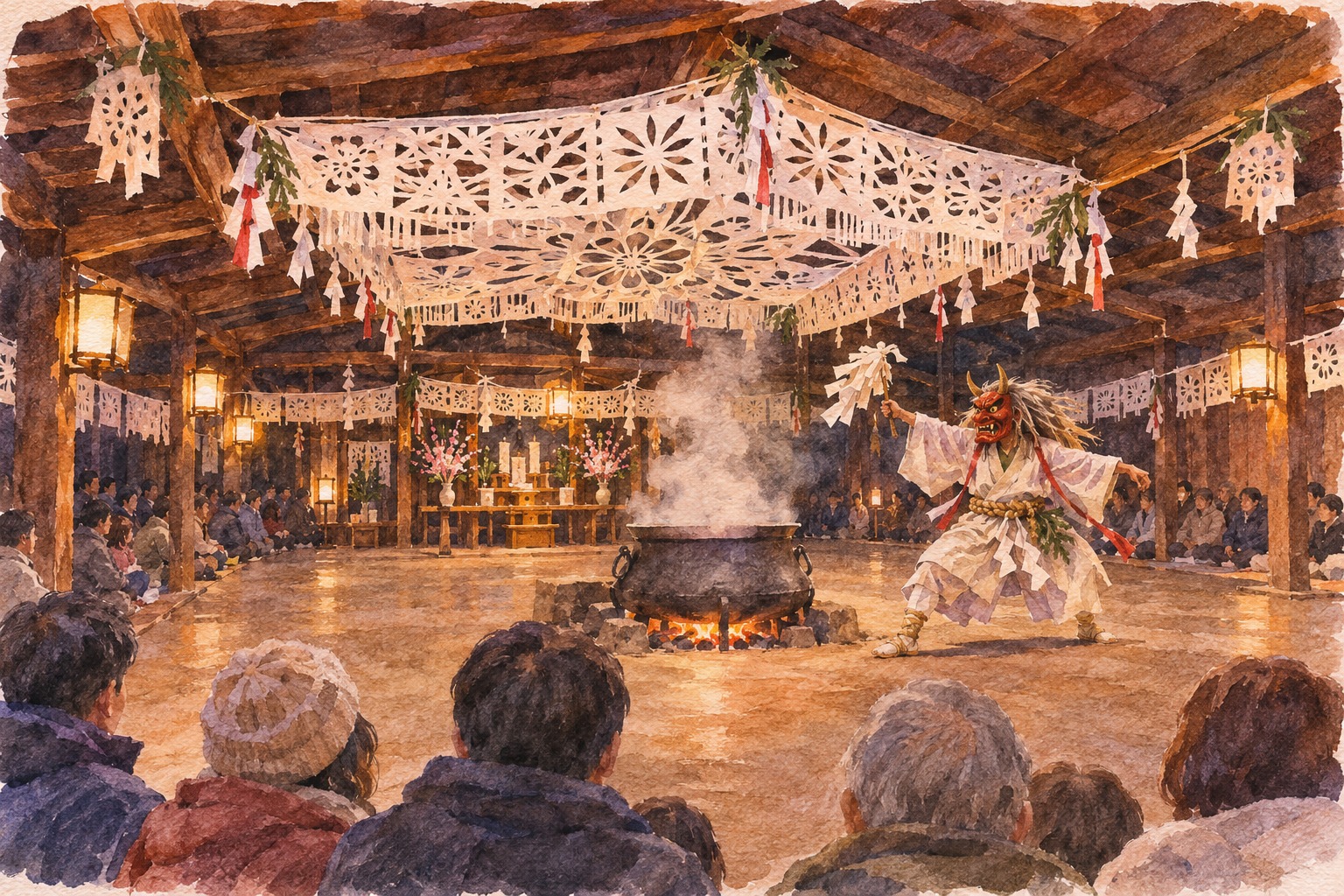
Okumikawa · Aichi · November to January · overnight
Not the April Buddha’s-birthday Hanamatsuri. In the mountain town of Toei, a seven-hundred-year-old ritual runs through the dark in one small village hall after another, and the best part happens at dawn.
You have done the autumn leaves at Kōrankei (香嵐渓) and you know what a crowded Nagoya weekend looks like. This is the opposite kind of November trip: you stand in a village hall or a shrine yard in the mountains from dusk until after sunrise, and the whole thing is free.
The festival is the Hanamatsuri (花祭) of the Okumikawa (奥三河) region, where Aichi, Shizuoka and Nagano meet. Each village holds its own night, on its own date, between November and January. The Aichi prefecture tourism site says the ritual is a designated national Important Intangible Folk Cultural Property, that it has been handed down since the Kamakura period, and that about forty kinds of dance are performed through the night. The Hanamatsuri Hall page says it has been handed down for 700 years. It is a Shinto ritual to drive off bad spirits and pray for the harvest and health. It is also, according to the same page, a night where the audience is expected to join in: the crowd shouts “tē-hoe, tē-hoe” (て~ほへ、てほへ) along with the dancers.
The problem for a visitor is not finding a Hanamatsuri. It is choosing one. Toei Town lists a different village almost every weekend. In 2026 the run from mid-November to mid-December looks like this.
The villages are not copies of each other. The Aichi Now guide describes three “lines” (系) of Hanamatsuri in Toei, and gives a few differences you can actually watch for:
| Village | 2026 dates · hours | What the official page says |
|---|---|---|
| Kobayashi 小林 | 13–15 Nov · listed 15:00 to 1:00 (check) | The only one of the “Ōkawachi line”; faster beat, plainer gestures. |
| Misono 御園 | 14–15 Nov · 10:30 → 8:30 | “Ōiri line”; drums struck bouncing, a one-legged dance with arms spread like a crane. |
| Higashi-sonome 東薗目 | 21–22 Nov · 13:00 → 7:00 | A taiko group, Shidara (志多ら), performs with the dancers. Little parking: carpool. |
| Tsuki 月 | 21–22 Nov · 8:00 → 16:00 next day | Large hall, elaborate decoration. A demon throws a bonfire up with a broad axe. Moved to the third weekend of November from 2026. |
| Ashigome 足込 | 28–29 Nov · 8:00 → 10:00 next day | Many ritual decorations; dawn is the highlight. |
| Kōchi 河内 | 28–29 Nov · 18:00 → 9:00 next day | Held outdoors in a shrine yard. |
| Naka-shitara 中設楽 | 5–6 Dec · 13:00 → 15:00 next day | Strongly Shinto; demons carry the names of gods, and the Iwato-biraki (岩戸開, the sun goddess leaving her cave) is among the dances. |
| Naka-zaike 中在家 | 13 Dec · 8:00 → 23:00 | The only Hanamatsuri whose route of transmission is documented: it came from Ashigome in 1872 (Meiji 5). Too few households, so helpers come from elsewhere. |
The two-in-one weekend is the one to plan around if you have a single trip and want a full night. Ashigome and Kōchi differ in the way that matters most to a visitor: Ashigome runs a full day and night in a community hall, while Kōchi is outdoors and starts at 18:00.
The Aichi Now text for Ashigome is unusually specific about when to be awake. It says the best part is the dawn, when many accompanying demons appear on the floor at once. A beehive (蜂の巣) hangs from the canopy over the dancing ground; once the demon Mokichi-oni (茂吉鬼) knocks it down, people go to pick up what falls, and whoever gets a piece is said to receive a small blessing.
At the door, say: 見学させてもらってもいいですか (kengaku sasete moratte mo ii desu ka). Entry is free; the question is a courtesy to a village that is hosting you in its own hall.
If your idea of a festival is a fire and cold air, Kōchi is the other choice for 28–29 November. It is held in the grounds of Nagamine Shrine (長峯神社) and runs 18:00 → 9:00. The official description says that at dawn red, white and blue demons pierce a beehive hanging from the ceiling of the dancing ground with halberds, and that a coin falling from it, a “seed coin” (種銭, tanesen), kept in your wallet is said to mean you will not be short of money that year.
On the Saturday, fill the afternoon at the town’s Hanamatsuri Hall (花祭会館). It shows, with masks, costumes, ritual tools, old documents and film, how the festival works, and it has a model of a dancing ground with costumed figures. It is open 8:30–16:30 and closes only from 29 December to 3 January. Entry is ¥320 for the Hanamatsuri Hall alone, or ¥330 each for the museum and the folk-craft hall (the prefecture lists them as separate tickets). The page does not say whether the combined tickets save money; ask at the desk.
Toei Station (東栄駅) is on the JR Iida Line (飯田線), and the town bus (町営バス東栄線) runs from there to Hongō (本郷), 10 minutes’ walk from the Hanamatsuri Hall, according to Aichi Now. I could not verify any train or bus times, either from Toyohashi or at night. The only shuttle-bus timetable I found for the festival was from 2019 and is out of date. For Ashigome, the official directions are all by car. Taxis are the practical answer for a night arrival or a dawn departure; call ahead.
This is not a show with a seat and a start time. Hours are long and listed loosely; the times on the pages can change. I found nothing about English-language help at the venues. You will be cold. You may not find food at the venue. You will not be able to get away at 3 a.m. without a taxi you arranged earlier, so decide before you go whether you are staying till morning. If you cannot stay up the night, Naka-shitara on 5–6 Dec runs from 13:00 on the Saturday, which at least starts in daylight.
Saturday 28 November. This assumes you have a car or a taxi booked; I have not verified a public-transport way to do it.
If you are running late, drop the hall. Kōchi starts at 18:00 and Ashigome is already running, so you lose nothing but the museum.