Shimane · Matsue · nights of 20 and 25 November 2026
The Quieter Place the Gods Meet
Every November the gods of Japan are said to gather in Izumo. At Sada Shrine, northwest of Matsue, the gathering is a five-day hush: no music, no noise, no photographs. The records call it the oldest of the Izumo rites.
佐太神社の神在祭 · お忌さんMatsue, ShimaneFacts checked November 2026
You know the story, or your guidebook does: in the tenth month of the old calendar the gods of the whole country leave their home shrines and gather at Izumo Taisha, so everywhere else calls it Kannazuki (神無月), the "month without gods", and Izumo calls it Kamiarizuki (神在月), the month with gods. The English pages stop at Izumo Taisha and its beach ceremony. They rarely mention that several shrines near Matsue hold their own version.
Matsue City lists nine shrines around Izumo that hold a kamiari-sai (神在祭, "festival of the gods' presence"), including Sada Shrine (佐太神社), Kamosu Shrine (神魂神社), Taga Shrine (多賀神社) and Mezuki Shrine (売豆紀神社). Of these, Matsue's own cultural note says the earliest written account is Sada's. This article is about that one, and about why a shrine with the older record gets the smaller crowd.
Five days with the volume offお忌さん · Oimi-san
A Rurubu listing gives 20 to 25 November 2026 for Sada Shrine's kamiari-sai, locally called Oimi-san (お忌さん), "the taboo". On the night of the 20th the gods are welcomed at the shrine front (社頭). Until the night of the 25th, when they are sent off to a mountain called Kami-no-me-yama (神の目山), two kilometres away, the days are kept quiet: singing, instruments and noise are stopped. The listing adds in bold: no photography.
That is the whole event. There is no procession to stand behind a rope for, and no stall food. You come for the hush, and for the fact that it has been kept up.
Getting there: JR Matsue Station (松江駅) → bus 25 minutes → stop "Sada-jinja-mae" (佐太神社前) → 2 minutes' walk. By car, about 15 km from Matsue-nishi IC (Rurubu).
When: 20–25 Nov 2026 (Rurubu listing). Welcome on the night of the 20th; send-off on the night of the 25th.
Reality check: No start time for either night appears in what I found. The shrine office line is 0852-82-0668, answered 08:30–17:00, in Japanese.
Izumo Taisha's days are dated by a travel site and Sada's by Rurubu, so treat both as a plan, not a promise.
Why would the gods come to Sada?神在祭の由来
The Matsue note gives two reasons, and the change between them is the interesting part. From the late medieval period through the Edo period, Sada's main deity was Izanami (イザナミ). The story: she died in the tenth month in Izumo and was buried on the shrine's sacred hill. She is mother of the gods, so all of them gather, out of filial duty, at the place she was buried. Put plainly, the note says, they come for a memorial service.
That reading survives at Kamosu Shrine, which also enshrines Izanami. Near Sada, Kamosu and Kumano Taisha there are also local places claimed as her burial site.
In the Meiji era Sada's chief deity became Sada-no-Ōkami (佐太大神) again, and the funeral reading no longer fit. The explanation pushed instead was the harvest festival: gods gathering to offer new grain at a sacred mountain described in the Izumo no Kuni Fudoki (出雲国風土記). The same note adds a detail you can check against the calendar: Sada is the only shrine that also holds this rite in spring. It was once April, now May, and the rite is nearly the same as the November one. One festival is a prayer for the harvest to come and the other thanks for it.
One rite, two stories: a funeral and a harvest festival.
What you can actually see社頭 · shatō
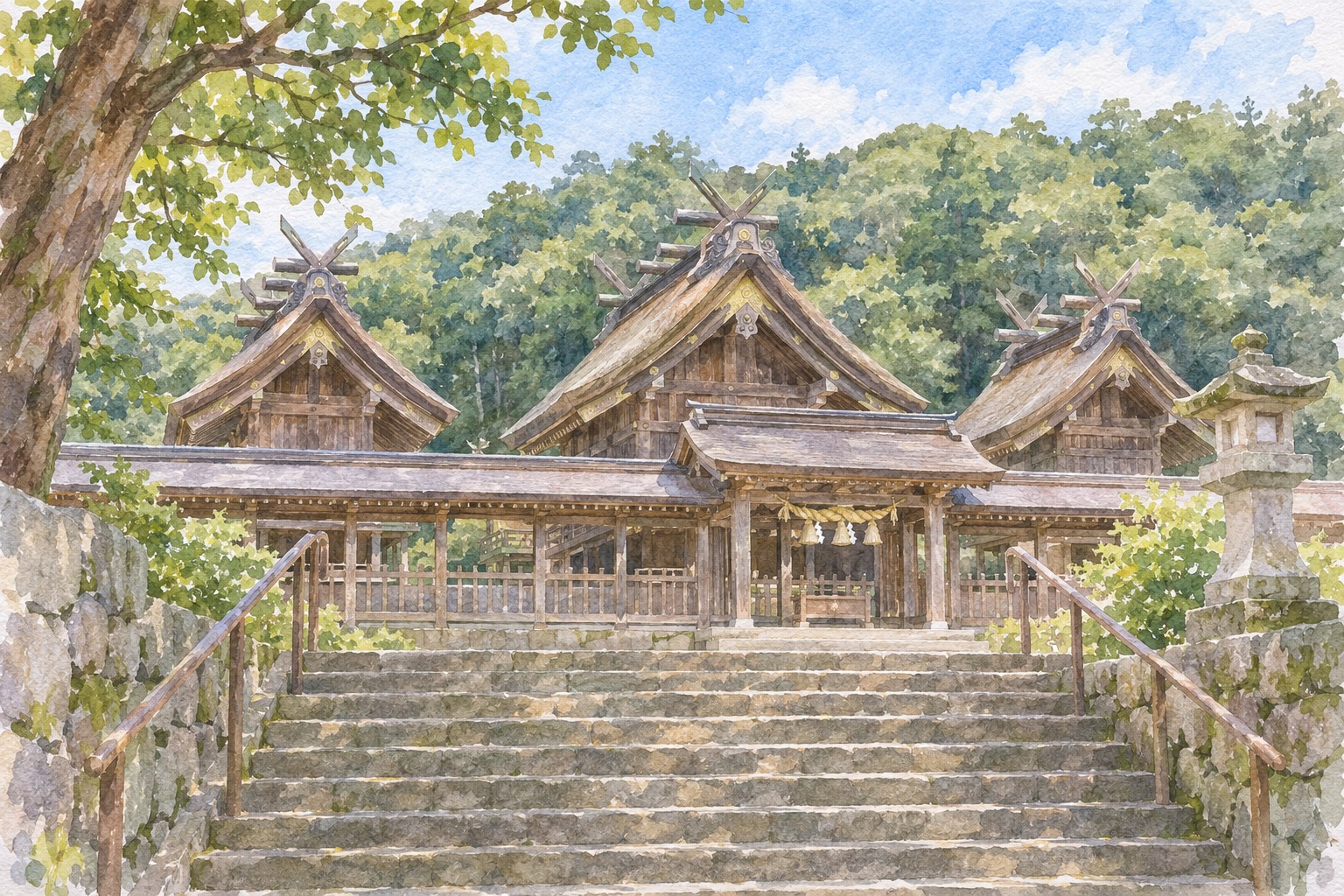
Sada Shrine has three main halls in the Taisha-zukuri style (大社造), the same style as Izumo Taisha. English Wikipedia lists the north, central and south halls, dated 1807, as Important Cultural Properties. Matsue's tourism page calls it a rare case of three such halls side by side. In daylight on any other day of the year, that is a good enough reason to come.
On the kamiari-sai nights, the rite itself is out of your sight: a Kokugakuin University record describes priests leaving the shrine in the middle of the night and walking to a pond near the mountaintop, treating it as a ship-boarding ceremony for the gods. You are not invited up there. What you can do is stand near the shrine front in the dark, silent like everyone else, and let it go on without you.
AI-generated illustration — not an on-site photograph. An imagined scene inspired by this section, not an accurate depiction of the real place, objects or event.
At the bus stop, confirm you are in the right place: 佐太神社前で降ります (Sada-jinja-mae de orimasu). To ask the shrine office about the time: 神迎えは何時からですか (kamimukae wa nanji kara desu ka).
The honest part
This is not a spectacle. The rites are conducted for the gods, not an audience, photography is banned, and the instruction is to keep quiet. If you want fire, lanterns and a crowd, go to Izumo Taisha for its beach welcome. If you want proof you were there, you will come home with none.
I could not find an hour for either night's rite, and the dates come from a listing site, so a phone call to the shrine (in Japanese) is part of the plan. I also do not know the last bus back to Matsue; the ride out is 25 minutes, and a night rite may outlast the buses, so have a taxi number ready. Matsue's own note claims only that this is the earliest written record, so I do not claim more.
If you only have one day
The night of Friday 20 November, assuming the shrine confirms the time:
Phone the shrine office (0852-82-0668, 08:30–17:00) to ask what time the welcome starts and where visitors may stand.
Spend it in Matsue, and take the Sada-jinja-mae bus from Matsue Station (松江駅). Allow 25 minutes plus the 2-minute walk.
Walk the grounds in daylight first. Look at the three halls, then wait quietly near the shrine front.
Stay for the welcome rite. No camera, no music from your phone.
Take the bus or the taxi you arranged back to Matsue.
If this does not work out, the send-off on the night of the 25th is the other chance. Both nights follow the same rule: say nothing, photograph nothing.
The shrine is a 25-minute bus ride away and the mountain a further 2 km; the priests walk it and you do not.