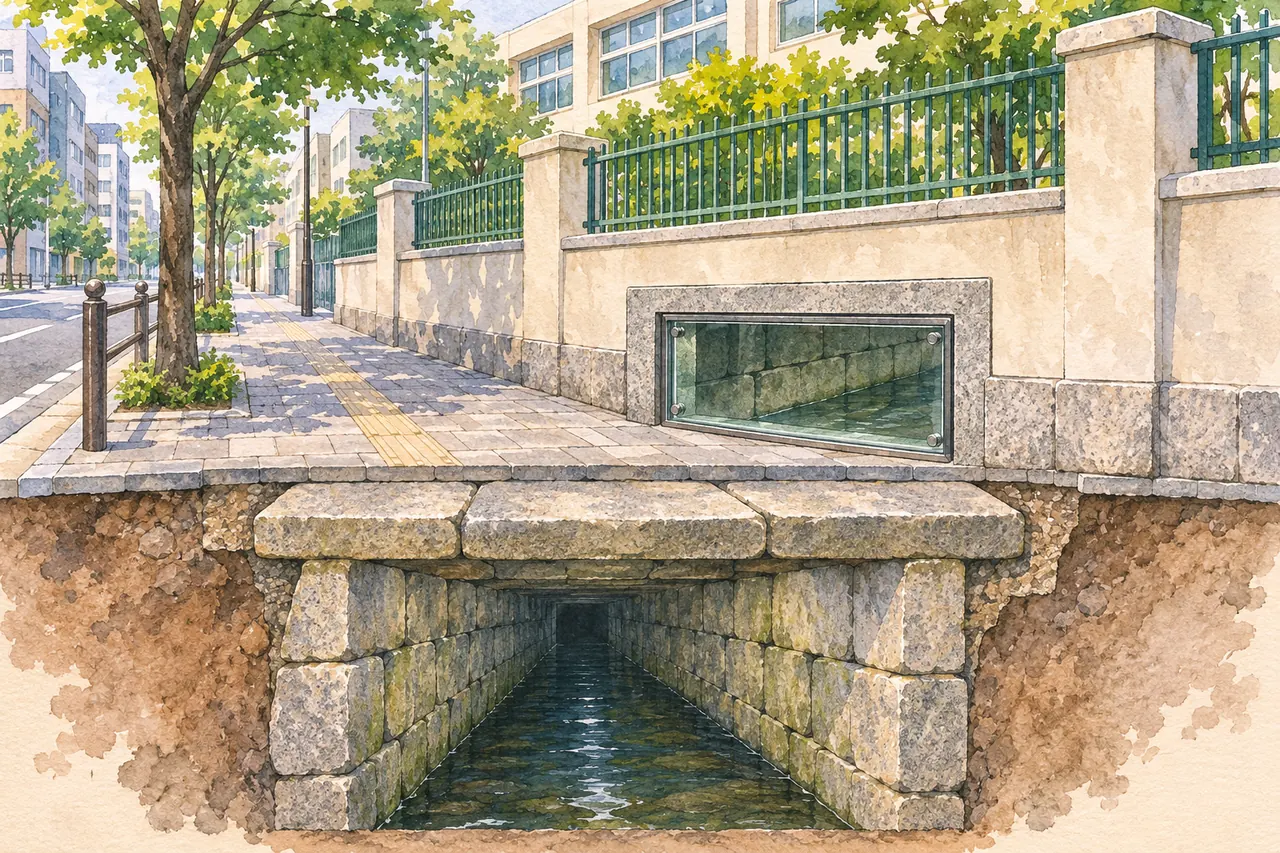
Ten minutes' walk from Osaka Castle, beside a primary school, there is a window in the pavement. Under it runs a stone channel that Osaka calls the Taikō Sewer, after Toyotomi Hideyoshi. It still carries the city's waste. The name is the least reliable thing about it.
AI-generated illustration. An imagined cutaway of the Taikō Sewer and its viewing window.
You have done Osaka Castle. You probably did it the standard way: the moat, the stone walls, the 1931 concrete keep with the lift inside. Most visitors then go back down to Morinomiya Station (森ノ宮駅) or Ōsakajōkōen Station (大阪城公園駅) and leave for Dōtonbori.
Go out the other side instead, to Tanimachi 4-chōme, and walk into the grid of streets to the southwest. This is the edge of the town that was laid out below the castle, and the grid is the reason this article exists. Every block was planned with a drain down its middle, and about seven kilometres of those drains are still working sewers today, protected as a city historic site.
What you give up: there is nothing to buy, nothing to photograph from a distance, and the best part (going underground) needs a phone booking in Japanese. What you get: the only place in Osaka where you can look straight down into the plumbing of the castle town, and a small lesson in how a famous name attaches itself to a thing.
Why a drain down the middle of every block背割 · sewari, "split at the back"
The castle town west of the castle, above all the merchant district of Senba (船場), was drawn as a grid of square blocks. An Osaka Metropolitan University lecture on the area describes blocks of roughly 40 ken a side, with house lots facing the east–west streets. The lots on the north side of a block and the lots on the south side met back to back along the block's midline. Along that back line ran a ditch.
That is what sewari means: the line where the block is split at the back. Each house drained out of its back yard into the shared channel, the channel ran to the rivers, and nobody's front door faced the drain. Osaka City's designation sheet defines the sewari gesui more drily, as a sewer at the boundary between neighbourhoods. The neighbourhood (chō) was the two rows of houses facing each other across a street, so the back drain was also where one chō ended and the next began.
The drain is not under a street. It runs through the middle of the block, so a neighbourhood is bounded by sewers on both sides, with its street in between.
The window by the school太閤(背割)下水見学施設 · Taikō (Sewari) Gesui Kengaku Shisetsu
The city built a small viewing facility in 2006 on the west side of Minami-Ōe Elementary School (南大江小学校). At street level there is a window. Look down through it and you see the channel as it was rebuilt in 1894: granite blocks stacked in courses on both side walls and a stone-lined floor. An Osaka City learning booklet gives the channel as about 2 m wide and 2 m deep, with seven courses of stone.
The window is open to the street. The city page says you can look in freely; the Osaka Metro guide site lists it as viewable at any hour with no closing days. That makes it a rare sight in Japan with no opening time at all, and also means there is nobody there to answer questions.
Getting there: Tanimachi 4-chōme Station (谷町四丁目駅, Tanimachi and Chūō lines), Exit 8, about 5 minutes on foot. Address for maps: 大阪市中央区農人橋1-3-3.
When: The window can be viewed at any time.
Cost: Free.
Reality check: It is a window and a few panels, in Japanese, next to a school. Five minutes is enough unless you have booked the underground visit.
Going down地下施設見学 · chika shisetsu kengaku
You can also go underground into the viewing chamber, with a guide. You cannot do it on your own: staff test the air for gas before anyone enters. The visit lasts about 20 minutes and is free. It is booked by phone through the city's contractor, the Urban Technology Center (一般財団法人 都市技術センター). Underground visits were stopped for a time because of an equipment fault and restarted on 1 March 2023.
When they answer the phone, the sentence you need is:
太閤下水の地下見学を予約したいです (taikō gesui no chika kengaku o yoyaku shitai desu). Then give the date you want and the number of people.
Booking: Tel 06-4963-2092, weekdays 9:00–17:30. No bookings on public holidays or 29 December–3 January.
Length: About 20 minutes. Free.
Reality check: No source says the tour is offered in English, and none states how far ahead to book or how many people can go at once. Call well before your trip, or ask your hotel to call for you.
What "Taikō" is doing in the name太閤 · taikō, the title Hideyoshi took in retirement
The story everyone repeats: Hideyoshi began building Osaka Castle in 1583, laid out a town below it, and built stone drains for the townhouses. Osaka City's own facility page says the sewers are said to date from that castle-town plan.
The city's cultural-property sheet is more careful, and it is worth reading because it is the document that protects the site. It says excavations have not confirmed that any surviving stone sewer goes back to the Toyotomi period. A dig next to Minami-Ōe Elementary School found an unlined earth ditch from the early Edo period, then a stone-lined ditch built in the same line in the late Edo period. A town map from 1648–1658 already shows a waterway here. So the line of the drain is old. The stones you see are not Hideyoshi's.
That is also why the legal name of the historic site does not say Taikō at all. It is designated as the sewer bed of the 1894 Central District Sewer Improvement Project (中央部下水道改良事業), Osaka's first modern sewer scheme. Between 1894 and 1897 the city poured concrete into the channel beds to give them a U-shaped floor, finished them with mortar and covered the open ditches with stone slabs. A column on Osaka Castle's stone-wall research site goes further: it argues that Senba's first drains were probably timber, and that the names sewari gesui and Taikō gesui only came into use from the 1970s. Edo-period maps simply call the channels suidō (水道), waterways.
Three hundred years separate the name from the stonework you can actually see.
What is down there, in section石組 · ishigumi, stonework
The section below is drawn from the dimensions the city gives: about 2 m by 2 m, granite side walls, a concrete U-shaped floor from the 1890s and stone slabs on top. Today it is still part of the working network. About 7 km of these old sewers are designated as a historic site, out of roughly 20 km of the old system still in use. The 1894–97 project as a whole covered 120 km.
Schematic, not to scale in detail. The walls are stone; the curve at the bottom is the Meiji city's concrete, poured into an older ditch.
Walking the grid afterwards船場 · Senba
The sewers themselves are covered, so you cannot follow them on the surface. No source we found says the back lines can still be traced in today's plots. What you can still read is the grid itself. From the viewing window, walk west across the Higashi-Yokobori River (東横堀川) at Nōninbashi (農人橋) into Senba, where the streets still run in the same east–west, north–south pattern. If you have read our piece on Dōshōmachi's medicine street, this is the same district, about 15 minutes' walk further on.
Look down too. Osaka's standard manhole cover shows Osaka Castle, chosen by public competition in 1994 to mark a hundred years since the start of the city's sewer works, which is to say since the 1894 project whose stones you just looked at.
The window sits between the castle and the merchant grid it was built to drain: you can walk castle, sewer and Senba in one line.
If you want more sewer: the science museum大阪市下水道科学館 · Ōsaka-shi Gesuidō Kagakukan
The city's sewer museum is out by the mouth of the Yodo River in Konohana Ward. It reopened in April 2022 after a four-year renovation and is aimed at school groups, but it is free and explains the whole system the Taikō channels feed into. A 2026 city page refers to it under a new sponsored name, ミザック下水道科学館OSAKA, so expect either name on signs.
Getting there: Hanshin Main Line to Yodogawa Station (淀川駅, local trains), about 7 minutes on foot.
When: 9:30–17:00, last entry 16:30. Closed Wednesdays (the next day if Wednesday is a holiday) and over New Year.
Reality check: No source we found says the museum has a Taikō Sewer exhibit. Go for the system, not for Hideyoshi. Hours could change with the renaming; check before you go.
The honest part
The free version of this is a window in the ground. If you have not booked the underground visit, you will spend five minutes looking at wet stone through glass, read some Japanese panels and leave. It is worth it only if you like knowing what is under a city, or you are passing anyway between the castle and Senba.
The underground visit is the real thing, and it is hard to get. Booking is by phone, on weekdays, in Japanese, with no stated English support. If you cannot arrange that, do not build a day around it.
And do not come for Hideyoshi. The name sells the place, but the protected stones are Meiji civil engineering on a line that is certainly Edo-period and possibly older. If anyone tells you these are Hideyoshi's stones, the city's own heritage sheet disagrees with them.
If you only have one day
A weekday, so that you can also have booked the underground visit by phone (if you could not, just skip that line).
Osaka Castle grounds, the way you have done before or a lap of the outer moat if you have seen the keep.
Walk out to Tanimachi 4-chōme Station and take Exit 8. Five minutes to the window beside Minami-Ōe Elementary School.
The window. If you booked, the 20-minute underground visit.
Walk west over Nōninbashi into Senba. Look down for castle manhole covers on the way.
Lunch in Senba, then the Dōshōmachi medicine street if you have not walked it.
To Ōsaka-Umeda Station (大阪梅田駅), then the Hanshin local train to Yodogawa Station for the sewer museum (not on a Wednesday).
Last entry at the museum. Back to Umeda.
Running late? Drop the museum. The castle, the window and the walk into Senba are the core, and they fit in a morning.