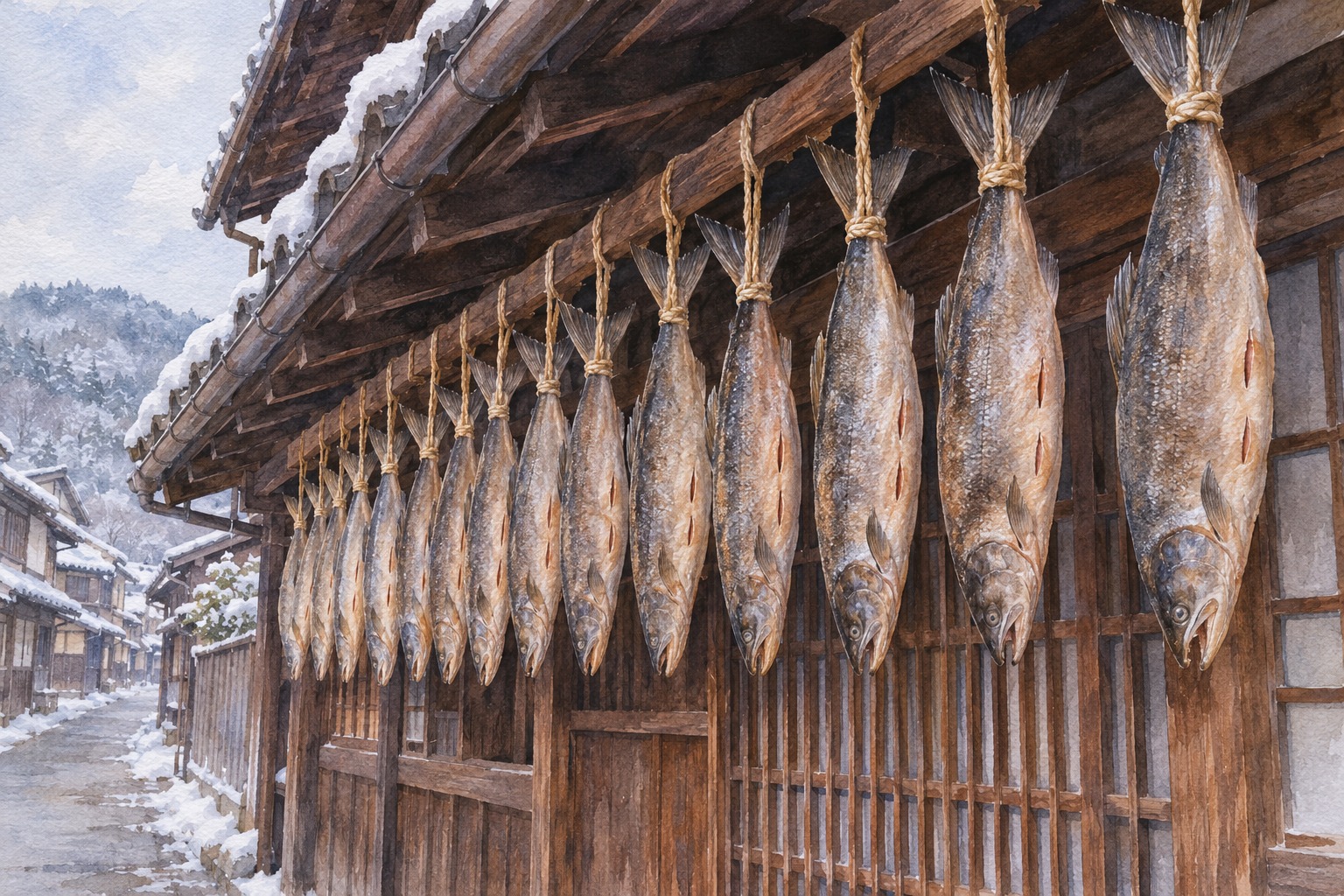
Niigata · December · a castle town, a river and two weeks of drying
For three weeks every December, about 150 salted salmon dangle from the eaves of a samurai-town street on the Japan Sea coast. The way they hang, and the way they are cut, are a polite refusal of two things the town would rather not picture.
You have done the sea of Japan side at its easy end: Kanazawa, perhaps Toyama, maybe a night at an onsen with crab. Murakami (村上) is further up the coast, in northern Niigata, and it has no famous gate or garden. What it has is a street of old merchant houses and, in December, a row of fish with their heads pointing at the ground.
This is a trip for the first three weeks of December. Murakami's tourist association has held the street display from 1 to 20 December in recent years. The 2026 dates are not announced where I could find them, so check before you book.
A shiobiki-zake (塩引き鮭) is a whole salmon, gutted, packed in salt for several days, rinsed, and hung in the cold wind to dry. Many places in Japan do some version of this. Murakami does it with a rule set. According to the city and the prefecture's tourism text, the fish are hung with the head down so they do not recall a hanged man, and the belly is not cut open in full: a stretch is left joined, a cut the town calls tomebara (止め腹, "stopped belly"), because a fully opened belly recalls seppuku. Murakami was a castle town of a samurai domain, and this is the explanation people give for how the fish are prepared there.
I would treat that as local tradition rather than documented history. None of the sources I found says when the practice began. It is still a clearer reason for a hanging fish than most.
The river is the Miomote (三面川). Salmon return to the river they were born in, and the domain's samurai Aoto Buheiji (青砥武平治) is the name tied to the idea that you can protect that habit. The city's own sign calls the domain's "seed river" system (種川の制, tanekawa no sei) a protection-and-breeding scheme without parallel in the fisheries history of the time. Tourism writers go further and call him the first to hatch salmon artificially. The sign's claim is the safer one to repeat.
The Iyoboya Salmon Museum (イヨボヤ会館) is where the river and this history sit side by side. It is advertised as Japan's first salmon museum, with windows onto a side channel of the river, and autumn is when fish are in it.
The display runs along Komachizaka (小町坂) toward Shōnai-machi (庄内町). It is a residential street and the tourism listing says so twice. Fish hang on private houses; stand back, do not touch, do not lean in a doorway.
For a look inside, use Sennenzake Kikkawa (千年鮭 きっかわ, Ōmachi 1-20), the shop and old merchant house where salmon hang from the beams indoors. The tourism board lists viewing as free, photography as allowed, and says reservation is required; the number is 0254-53-2213. Its hours are listed as 9:00 to 18:00 by the prefecture's tourism page and 9:00 to 17:30 by another site, and it is open every day but 1 January. Ask for permission with:
At the door, say: 見学させてください (kengaku sasete kudasai). Then: 写真を撮ってもいいですか (shashin o totte mo ii desu ka).
The same company runs a salmon-meal restaurant, Izutsuya (井筒屋), a separate shop with its own hours. I have not verified them.
From Murakami Station it is about 5 minutes by bus to the Kosuke-jima (小助島) stop, then 3 minutes on foot. Admission is listed at ¥600 for adults and ¥300 for children, though one source says ¥700; last entry 16:30 for a 17:00 close, shorter in January and February, and closed 28 December to 4 January. One listing also says Wednesdays; others do not. I would call first.
Late in the year the museum has run a salting workshop (塩引き道場) for visitors in late November and early December, a class that fills early, according to old prefectural pages. I could not find 2026 details.
This is a long way for a photograph of dead fish on a street, and Murakami is not an easy town. In December the Japan Sea side is cold and often wet, and light in the afternoon is poor. If the street display has not reached 1 December you will see little. If you go on 19 or 20 December, you may find fish already taken down. The street is people's homes; some will be irritated by tour groups, and no one owes you a doorway. Inside Kikkawa you may need a reservation and a phone call in Japanese. And the seppuku story is told as the reason; it is not a documented date, so do not repeat it as fact.
A day from Niigata Station, on a weekday between 3 and 18 December. Train times are not given because I have not checked 2026 timetables.