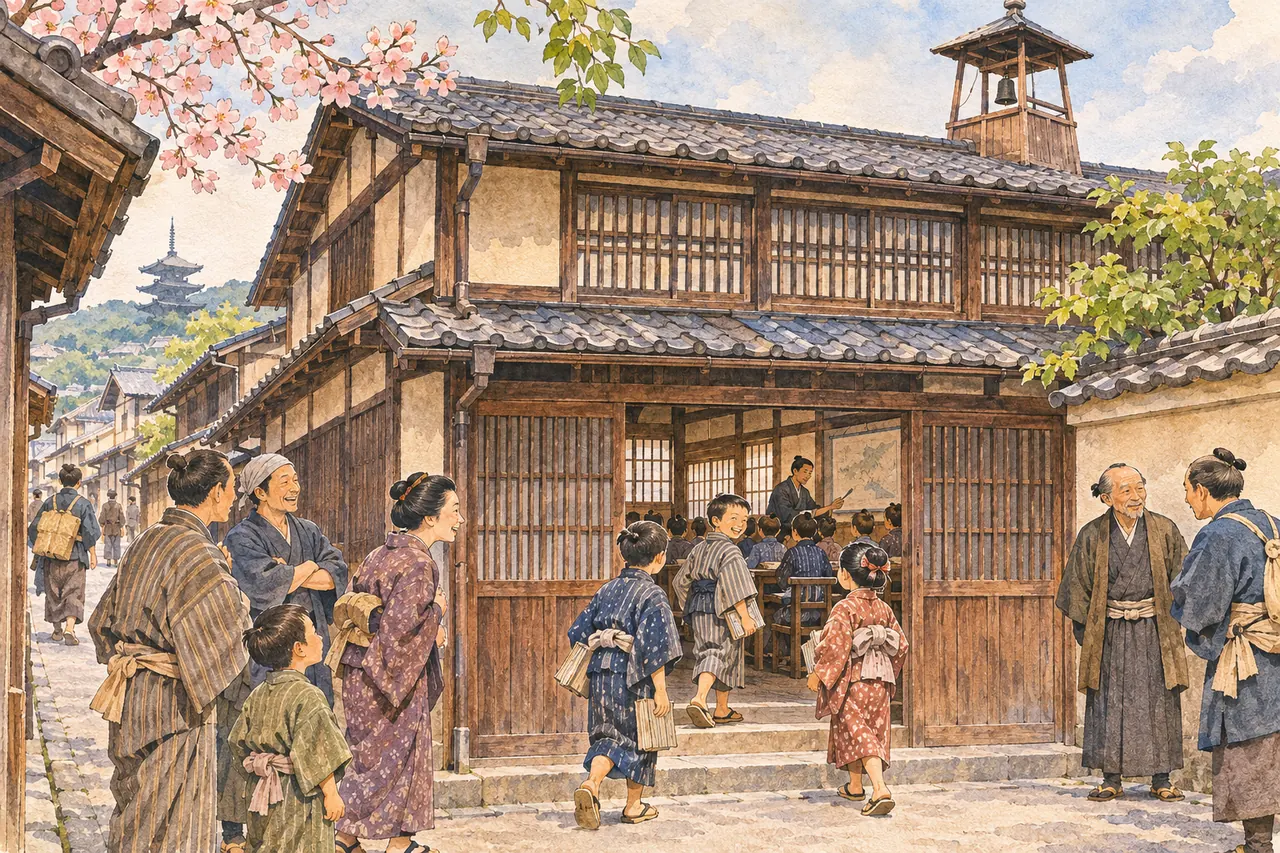
You probably went into the Kyoto International Manga Museum for the manga. You may have noticed the corridors were a little too wide and the stairs a little too shallow for a museum, and that there was a lawn out front where a schoolyard would be. That is because it was a schoolyard. The building was Tatsuike Primary School (龍池小学校), and it was founded not by the state but by the households of the streets around it.
This is a walk through four of those buildings in the grid between Oike and Bukkōji, plus one you can only see from the street. You give up the big sights for an afternoon. What you get is the answer to a question nobody at the Manga Museum ticket desk will explain: why a city of temples has its best civic architecture in old primary schools.
What a bangumi was番組 · bangumi
Today bangumi means a TV programme. In Kyoto in 1869 it meant a numbered group of neighbourhoods. The city's blocks had long been organised into self-governing street associations, and in the first years of Meiji these were regrouped into 65 numbered units: 33 in Kamigyō, the upper city, and 32 in Shimogyō, the lower city. Each unit was told to build a school. Two groups shared one, which is why the number you will see everywhere is 64.
The first two opened together on the 21st day of the fifth month of 1869 by the old calendar: Kamigyō No. 27, later renamed Ryūchi (柳池), and Shimogyō No. 14, later Shūtoku (修徳). By the end of that year all 64 were running. Japan's national education law, the Gakusei (学制), came in 1872. When it arrived, Kyoto simply turned its existing bangumi into the new school districts.
It happened in the same year the court left for Tokyo. A city that had been the capital for over a thousand years had good reason to wonder what it would be without the emperor, and what it chose to spend money on was its children.
Who paid: the stove money竈金 · kamadokin
The money came from kamadokin, "stove money". Every household with a cooking stove, which is to say every household, paid into the school's fund. According to accounts of the period, the rule was that you paid whether or not you had children, with the amount scaled to the size or means of the household. One railway-company history of the schools puts the levy at one bu of gold every six months; that figure comes from a single source and is best read as an order of magnitude.
Because the neighbourhood paid, the neighbourhood used the building for more than lessons. A bangumi school was also the local office, the meeting hall, and in many cases had a police box on the ground floor. Some carried a fire-watch tower, a bōkarō (望火楼), on the roof, with a bell to raise the alarm. The school was the town hall of a few dozen streets.
Why the buildings are still here元学区 · moto-gakku
By the 1990s the downtown grid had emptied of children, and one school after another was merged and closed: Kaichi in 1992, Meirin in 1993, Rissei around 1993, Tatsuike in 1995. In most Japanese cities a closed school is sold or knocked down. In Kyoto the city owns them, since the land and buildings were handed over in 1941, but the neighbourhoods never stopped behaving as if they had a say, and in practice they do. Tatsuike's residents turned down a plan for a library before the Manga Museum was agreed. In Kiyomizu the residents' federation chose the hotel operator.
The old school district, the moto-gakku (元学区), is still the unit that runs neighbourhood life. Rissei's residents' federation, for example, covers 24 street associations and holds a cherry-blossom festival, a bon dance and a sports day every year, now on the old schoolyard in front of a hotel. When you see a notice board with 「元〇〇学区」 on it, that is a school that closed thirty years ago and is still organising its streets.
Kyoto Municipal Museum of School History京都市学校歴史博物館 · former Kaichi School
Start here, because it is the only place that tells the whole story. The museum is the former Kaichi Primary School (開智小学校), which opened in 1869 as Shimogyō No. 11 and closed in 1992. The main gate and stone wall are registered cultural properties. The entrance porch was moved here from another closed bangumi school, Seitoku, which is a good summary of the whole system: when one school closed, a neighbour took its door.
Inside are textbooks, desks and the objects that neighbourhoods donated to their schools, which tell you more about the streets than about education. Until 20 December 2026 the special exhibition is on Kyoto's modern school architecture, which is the right one to see before walking past the buildings themselves.
Kyoto International Manga Museum京都国際マンガミュージアム · former Tatsuike School
You may already have been. Go back and look at the building instead of the shelves. Tatsuike was Kamigyō No. 25 and closed in 1995. The deal that made it a museum left the neighbourhood with the old principal's office, three rooms and use of the grounds. That is why, on some days, the lawn is full of local children rather than tourists: it is still, in part, their school.
Kyoto Art Center京都芸術センター · former Meirin School
Ten minutes' walk south, on Muromachi-dōri, the street of the kimono wholesalers. The building of the former Meirin Primary School (明倫小学校) went up in 1931, when the textile trade was rich and the neighbourhood wanted the whole city to know it. The school closed in 1993 and the art centre opened in 2000. Entry is free, and you can wander the corridors, the old classrooms used as studios and the tatami rooms. This is the best of the five for simply looking at what a wealthy neighbourhood built for its children.
If a room is closed off and you want to know whether you can look in, ask at the front desk: 見学できますか (kengaku dekimasu ka).
Rissei, on the Takase River元立誠小学校 · Rissei Garden Hulic Kyoto
Rissei School stands on Kiyamachi, the bar street along the little Takase canal, where you have probably walked at night without registering the building. It went up in 1926 and is described as the oldest surviving reinforced-concrete school in the city. After it closed, the building sat in limbo for years until a joint project between the city, a developer and the residents' federation. In July 2020 it reopened: the upper floors are The Gate Hotel's "schoolhouse" rooms, the ground floor holds the neighbourhood's own meeting hall and a library, and the old schoolyard is a public plaza open to anyone.
You do not need to stay at the hotel. Walk into the plaza, look up at the 1920s façade, and note that the residents' association office is still on the ground floor of a luxury hotel.
The tower you can only look at元有済小学校 · former Yūsai School
Across the Kamo River, near Keihan Sanjō Station, the roof of the former Yūsai Primary School (有済小学校) carries a fire-watch tower that is said to be the last surviving one from a bangumi school. The school closed in March 2004. The building is not open, and its future is undecided: in May 2026 the city began asking companies for redevelopment ideas, at the request of the local residents' council. If you want to see a bōkarō, see it from the street now.
| Building | Was | Closed | Now | Go inside? |
|---|---|---|---|---|
| School History Museum | Kaichi (Shimogyō No. 11) | 1992 | museum | ¥300, closed Wed |
| Manga Museum | Tatsuike (Kamigyō No. 25) | 1995 | museum + community rooms | ¥1,200, closed Wed |
| Kyoto Art Center | Meirin | 1993 | arts centre | free |
| Rissei | Rissei | c. 1993 | hotel, hall, plaza | plaza only |
| Hotel Seiryu | Kiyomizu (Shimogyō No. 27) | 2011 | hotel | guests |
| Former Yūsai | Yūsai | 2004 | empty, redevelopment pending | no |
The honest part
This is a walk about buildings and an idea, not about things to do. If you are not interested in how a city organised itself, it is four old schools and a lot of Japanese-only labels.
The two best interiors, the School History Museum and the Manga Museum, both close on Wednesdays. Plan the day for any other day of the week.
The Kiyomizu school, now The Hotel Seiryu Kyoto Kiyomizu, sits below Kiyomizu-dera and is the most photogenic of all of them, but it is a hotel. I could not confirm what non-guests are allowed to see, so it is not in the route.
A lot of what is written about these schools, in Japanese too, rests on a handful of sources. Where a figure here comes from only one of them, it says so.
If you only have one day
This fits into an afternoon. Any day but Wednesday.
- Lunch near Karasuma-Oike. Then into the Manga Museum, and spend the first twenty minutes on the building, not the shelves.
- Walk south on Muromachi to the Kyoto Art Center (10 min). Corridors, stairs, tatami rooms.
- East along Takoyakushi to Kiyamachi (15 min). The Rissei plaza and façade.
- South down Kiyamachi and across to Gokomachi, then to the School History Museum (15 min). You need the full hour before last entry at 16:30.
- If you still have light, walk to Keihan Sanjō (20 min) and look up at the Yūsai tower. If you are running late, drop this.