Mie · Taiki Town · Sunday 15 November 2026
South of Ise, in a mountain village with its own dairy, there is a shrine whose god is a skull. People go there to pray about everything above the neck: exams, memory, headaches. On the third Sunday of November it holds a festival with mochi pounding, mochi throwing and a rakugo storyteller.
You have walked the gravel at Ise Jingū (伊勢神宮) and maybe a stretch of the Kumano Kodō. The ordinary Mie shrine trip ends there. This is the thing that the Ise-Shima day trip does not mention: a mountain shrine whose own official history opens with children playing with a skull in a stream.
First, a note on the name. Kōbe (こうべ) here is not the port city of Kobe (神戸). It is an old word for the head or the neck, and the shrine’s first name, according to its own site, was Kōbe-no-miya (首の宮), “the head’s shrine”. I found one listing in English, an automated translation on the Mie tourism site, and nothing that tells the story.
The shrine’s official account is a short folk tale. After the death of a nobleman named Karahashi Chūjō Mitsumori (唐橋中将光盛), who is said to have lived in a fortress on a cliff above the valley and to have been a descendant of Emperor Kanmu (桓武天皇, the emperor who built Heian-kyō), village children found a skull floating down the Karako River (唐子川) and played with it in the water. An old man who passed by told them it was unclean and sent them home. Then he began to shout in another voice: he was Mitsumori, he had been enjoying the game, and the old man had insulted him. If the villagers honoured the skull, he would end the old man’s madness and protect everyone. They built a shrine.
The shrine says it was founded in 1191. Then, in 1708, the kami appeared in a person’s dream and gave a new instruction: from now on, call me Yomō (四方), the four directions. The villagers met, decided that 16 November would be the festival day, and made the shrine the guardian of the four villages that then made up Ōuchiyama. That is why the full name has both a head and a compass in it: head protection and, through the “four directions”, protection from bad luck and directional taboos.
The shrine also says (as its own claim, which I did not check) that it is the only shrine in Japan named for the head. Nothing in its own text says the skull is shown to visitors. Do not go expecting to see it.
The grounds are small and the list of things in them comes from the shrine’s own guide. A spring called the Kōbe-no-mizu (頭之水, “water of wisdom”) comes out near the main hall; on the first Sunday of February there is a water-drawing rite there. Near it sits a rock that shows several faces; you stroke the part of it that corresponds to the part of you that hurts. It is called Okashira-san (お頭さん). Across the Karako River you can see a thin waterfall that you worship instead of standing under it, and there is a mossy cedar.
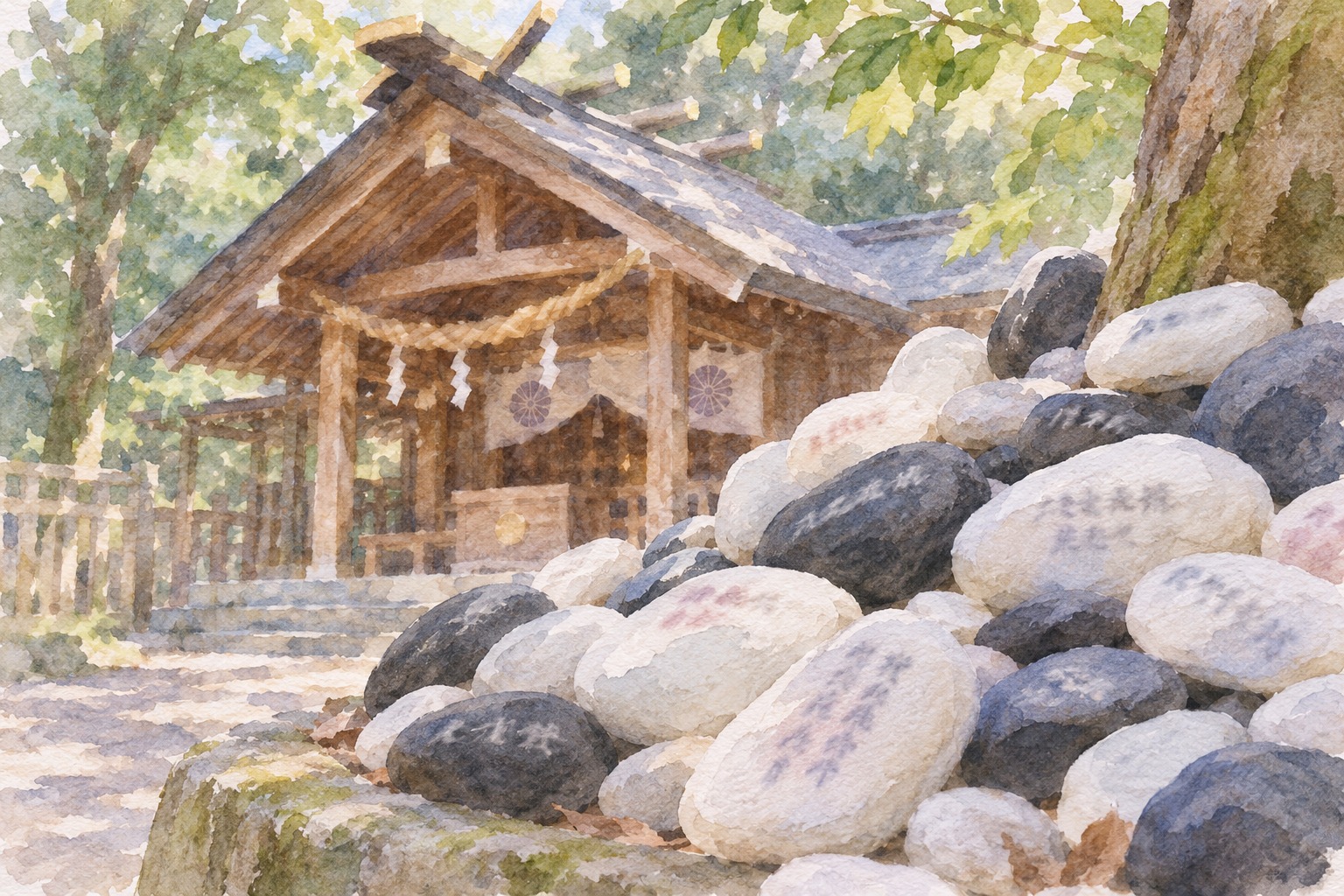
The strangest custom is the stone shelf (奉石所). The shrine explains that willpower is soft, so you hand it to something hard. You bring a white stone of five to six centimetres, washed in sea salt, and set it down with a vow, such as passing an exam or driving safely. When it is done, you come back with a black stone to say thank you. The shrine explains that the stones come from the far-away sea because the shrine is in the mountains. Now that stones are hard to find, it sells blank ema (無地絵馬, plain wooden wish plaques) instead, and says it is the birthplace of the blank ema.
At the shrine office (授与所), ask for a blank plaque: 無地の絵馬をください (muji no ema o kudasai). The price is not on the pages I read, so have coins ready.
There is also, in the shrine’s own blog, a goshuin stamp shaped like a motorcycle helmet, made with the helmet maker OGK Kabuto. It follows the same logic as everything else here.
The main festival day (例大祭) is fixed at 16 November, but the public celebration is held on the third Sunday of the month. This year that is 15 November. The shrine’s notice says the ceremony begins at 11:00, a rakugo performance is offered at about 13:45 by Katsura Jakuta (桂 雀太) and is open to anyone attending, and the “head fortune mochi” (頭之福餅), blessed by the head god, is thrown to the crowd at 15:00, weather permitting. The Mie tourism listing adds mochi pounding by the Erihara Haya-Mochitsuki Preservation Society (恵利原早餅つき保存会), whose method it calls rare in Japan, and says the pounded mochi is handed out on the spot. I could not find what makes the method unusual, or the time it is done.
Ōuchiyama Station (大内山駅) is on the JR Kisei Main Line (紀勢本線), and the station is unstaffed. The shrine is a 10-minute walk, per both the shrine and the tourism site. For the rest I only have partial figures. On a sample July date, the Rapid Mie (快速みえ) took 1 hour 32 minutes between Taki (多気) and Nagoya without changing, and you would change at Taki to a local south. I could not confirm the local trains, which are not frequent. Look up the exact connection the day before. By car it is about 5 minutes from the Kisei-Ōuchiyama interchange, with parking for 300 cars. The shrine’s access page lists taxi firms in Taiki, Odai, Kihoku and Matsusaka.
It is a long way for a small festival. The tourism listing calls the Sunday event a celebration and the shrine describes the main day as one date among 35 ceremonies a year, so I would expect a community-scale event, not a big one; I found no attendance figures. The trains are sparse, the English is nil, and the central object is not on view. If you come on any day other than a festival, you will find a quiet mountain shrine and a rock that looks like faces. The Mie tourism site says people come from across the prefecture and beyond for exam prayers and work luck, so you will not be the only visitor on a quiet day.
Sunday 15 November. I could not verify a train that gets you there by mid-morning; treat 10:30 as a target.
If you are running late, skip the rakugo and keep the 15:00 mochi.