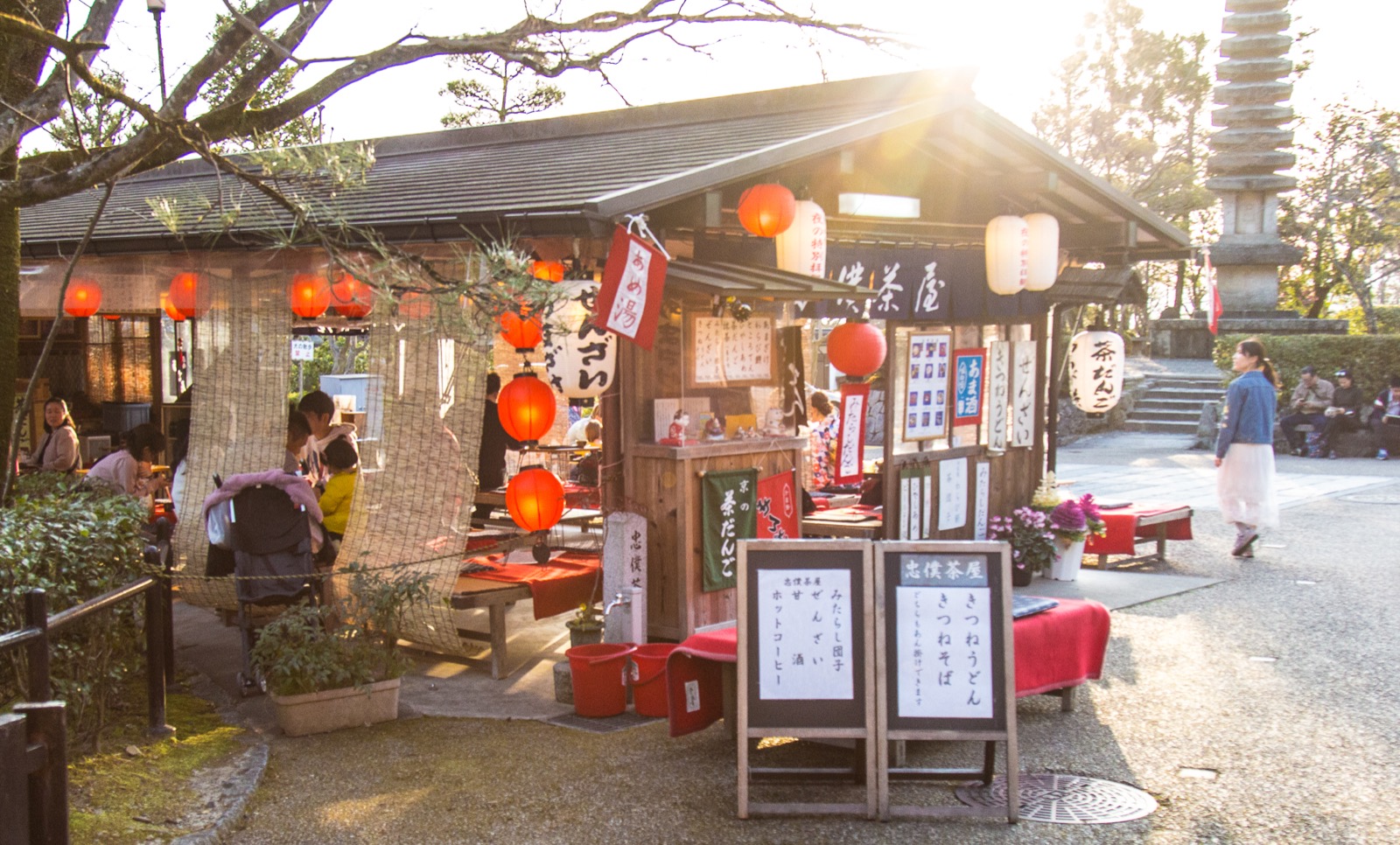
You have already stood on the stage at Kiyomizu-dera (清水寺, Kiyomizu-dera). On another visit, leave a little attention for the way out. One tea house carries a name that sounds less like a business than a verdict on somebody’s life: Chūboku Chaya (忠僕茶屋, Chūboku Chaya), the “loyal servant” tea house. The interesting question is what happened to that servant after the crisis was over.
This is a stop to fold into a temple visit, rather than a reason to cross Kyoto for lunch. The shop’s current hours are not verified. What you can bring with you is the story behind the two characters 忠僕, so that a place to sit becomes something more specific than another picturesque tea house.
1. Read the name before the menu
Chūboku is a description of a person, not a kind of tea. The person was Ōtsuki Jūsuke (大槻重助, Ōtsuki Jūsuke). Keep the whole shop name on your phone: 忠僕茶屋. It is the useful thing to match against the curtain or a sign, particularly when you are surrounded by other refreshments and have only half remembered the English title.
The photograph above gives you a concrete place to begin. Lanterns and menu boards compete for attention, but the name sits among them. Reading it changes what you notice. You are looking at a business whose identity preserves a judgement about its founder, not simply a shop named after the landscape.
On arrival: Look for 忠僕茶屋 in the southern garden area described below. When: During your temple visit; check whether the shop is serving. Reality: The 2018 photograph is a recognition aid, not a current menu.
2. The part after the dramatic escape
The temple’s history recounts that Jūsuke accompanied the monk Gesshō (月照, Gesshō) to Kyushu. After Gesshō’s death, he brought the monk’s belongings back to Kyoto, was imprisoned, and met Gesshō’s brother Shinkai (信海, Shinkai) in jail. Shinkai entrusted him with affairs after his death. Released, Jūsuke returned briefly to his birthplace, then came back to Kiyomizu-dera. He ran a tea house and tended the brothers’ graves for the rest of his life. In 1874 he received a memorial poem for Gesshō from Saigō Takamori (西郷隆盛, Saigō Takamori). [1]
That return is the centre of this story. A journey, an arrest and a release supply the events that fit neatly on a timeline. Maintaining graves belongs to a different kind of time: work that has to be done again. At the tea house, try reading the name with that repeated responsibility in mind. You do not need to turn the visit into a tour of every political figure connected with the temple.
3. A livelihood as a form of remembrance
Kiyomizu-dera explains that it granted tea-house operating rights to support the families of Jūsuke and another attendant. Jūsuke’s family business became known as Chūboku Chaya. Its 2011 account describes a fourth generation running it; that is a dated statement, not confirmation of who operates the shop in 2026. [2]
A memorial can be a stone with a name on it. Here the temple’s account also connects remembrance with earning a living. That makes an ordinary commercial stop worth reading carefully. It does not make every object inside historical, or turn whatever you order into a nineteenth-century recipe. Let the shop be a shop; the documented connection is substantial enough without adding a performance of the past.
4. Find the square, not a grave route
The temple places the tea house in the square with the eleven-storey stone tower, in the southern garden, Nan’en (南苑, Nan’en), along the return route. [3] Use that landmark together with the shop name. Do not mistake the diagram below for a shortcut through closed grounds.
The graves belong to the history, but this article does not establish public access to them. You can understand the tea house without seeking out a cemetery. If a sign or barrier changes the obvious route, follow the on-site directions. The point is to look more closely along a visit you are already making.
Getting there: From Kiyomizu-Gojō Station (清水五条駅, Kiyomizu-Gojō Eki), the temple gives approximately 25 minutes on foot to Kiyomizu-dera; allow additional time inside. [4]
When: Check the temple’s visit information and the shop’s operation separately. Reality: No verified current shop hours, closing days, payment methods or menu prices.
5. Make it a pause, not an interview
If the shop is open and you want to sit down, first establish whether it is still serving. When staff are available, ask 今、入れますか。 (Ima, hairemasu ka.) Then use the menu you are actually given. An old photograph can show a sign clearly and still be wrong about what is available today.
Keep any historical question brief and well timed. You have the temple’s written account to read beforehand; staff do not owe every visitor a retelling. A useful return visit can be as modest as recognising the name, having a drink if service is available, and leaving with a less anonymous picture of the people attached to this place.
The honest part
This is not a guaranteed quiet alternative to Kiyomizu-dera, and it is not a museum presentation. The shop may be closed when you arrive. Current opening hours, English service and the identity of the present operator remain unverified. If you need a reliable lunch reservation, make that arrangement elsewhere.
The historical source is the temple’s own commemorative account, published in 2011. Its language honours loyalty. This article explains that account; it does not claim to reconstruct Jūsuke’s private thoughts or verify every family detail independently. You may find the visit very small. It is supposed to be: a familiar exit route, read more closely.
If you only have one day
Suggested timing, not shop opening hours. Check current temple admission information before setting out; adjust this sequence if the permitted route or opening times require it.
- 09:30 · Kiyomizu-Gojō StationStart the walk to the temple, using the official 25-minute estimate as a baseline rather than a promise.
- 10:00 · Temple visitMake your visit without rushing toward the tea house.
- 11:15 · Southern gardenLook for the tower and the shop name. Stop if service is available; otherwise continue without waiting for an unconfirmed opening.
- 12:00 · Leave time for lunchContinue your Kyoto day with lunch arranged separately. Drop the tea stop if you are running late.